Flight 3b

Flight Summary

The mechanical aspects of Flight 3b went as designed and demonstrated the flight system has stabilized. The improvements to the tower structure, the capsule nose and the main recovery deployment system resulted in a picture perfect flight. In many ways this was an identical flight to 2d from last year with the capsule landing on the flight line (at Steve Pope's camp) in front of many spectators. (I think Steve and Joe have a thing going on)

The areas that still need improvement are the video tower, capsule camera and the launch tower.

Capsule Camera; Just days before flight I discovered the (heavily) modified Aiptek DV II for the cockpit no longer captured video (but would capture audio). An Aiptek PenCam SD (used in Flight 2b and 2c) was subsequently installed and worked well in all ground testing but failed at launch. My theory is that the initial G force of launch jolted the connections of the SD memory card just enough to shut down the recording process. I'm still reviewing this theory. I was able to recover some video from capsule but it stops short of lift off.

Tower Video; I was trying a new antenna position for the tower camera (BoosterVision Gear Cam) that worked well at close range but suffered from significant signal loss once the tracking system was moved to a safe launch distance. (In hind sight I should have tested that prior to launch).

The video from that is pretty unusable for entertainment purposes but there are brief moments where I can make out what is happening. I may choose to redesign the tower camera to use solid state capture or employ what I call the "Gumby protocol" for recording the downlink. This is a technique I used for many of the Gumby flights where I leave the receiver and recording device at the launch pad, with the patch antenna pointing up. This maximizes the signal capture during the boost phase of the launch but can result in signal loss when the rocket recovers.

Booster Video; This worked perfectly yielding wonderful footage of the flight (to be posted later). If there was anything I would consider changing here would be to come up with a higher resolution capture system. There are some stills of the capsule during free fall that are pretty cool.

Launch Pad/Camera; This time I had enough video tape in the dang thing to get the launch footage and it yielded some interesting information, the pad lifted off the ground about 2 inches during launch! Next time I plan to bring some rebar hooks out to anchor it, I may even build a blast deflector box or heck, even my own pad that resembles the Redstone launch platform. (we'll see).

Video footage from the booster

Images from the video

Flight 3a
 

  Videos

  •   Flight 3a launch from setup to touch down  WMV
  •   Escape Tower Camera at half speed    WMV   MOV
  •   Redstone Booster Camera (normal speed)  WMV   MOV


Redstone Booster Video Notes: 

You can see the tower come off about 50% into the flight (little flash of red). Though not the desired result, I did design the system to be able to survive this sort of event. (Previous version weren’t).

You can see the ejection charge puff at apogee followed by the free fall of the capsule.

The drogue chute for the booster's main chute got stuck in its deployment bag. The deployment bag (attached to the capsule)  broke free leaving the drogue still wrapped up.  You can see the wrapped drogue knocking against the side of the booster until it finds a nice calm spot between the fins.  This prevented the main chute from being extracted at apogee.

Eventually turbulence kicks the bag off and the chute briefly inflates then breaks free. Thankfully this stops the ballistic trajectory of the booster and it then begins a flat spin. This also aids in extracting the main chute which then fully inflates.

At landing you can see the right fin bend under the pressure (the fin is only “softened” and was trivial  to repair.)  Amazingly the booster suffers no other damage – considering the chute opened maybe 40 feet above the playa.

Escape Tower video Notes:  there is a bunch of signal noise but still this footage rocks! The best theory to why the tower came off is that the base support ring broke under the stress.  I had made it out of ¼” aircraft plywood but the drilled holes for the struts no doubt made it weaker.  I had meant to build this out of aluminum, but never got around to it (and the plywood seemed adequate).


The Mercury Joe Story
 

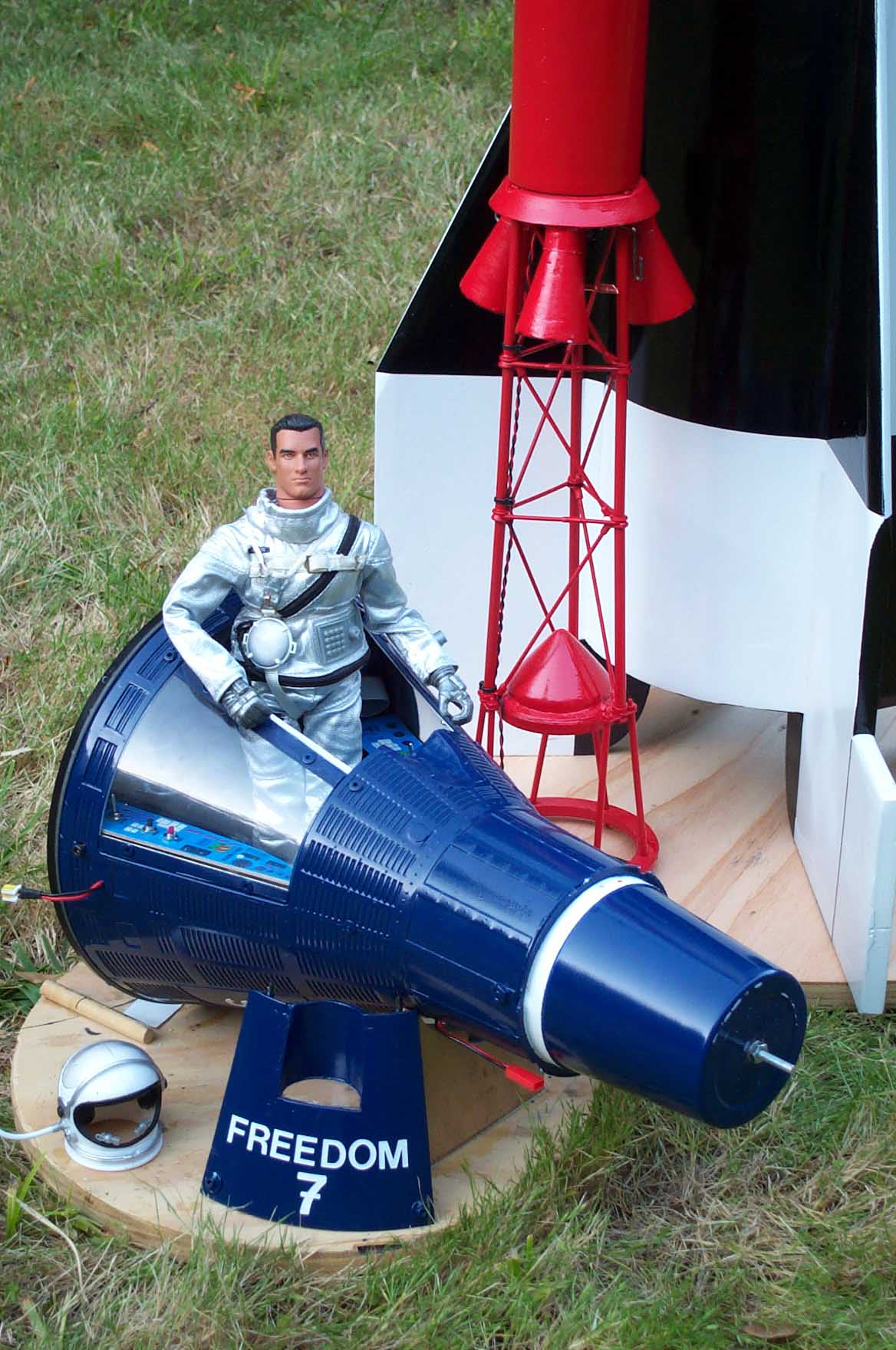
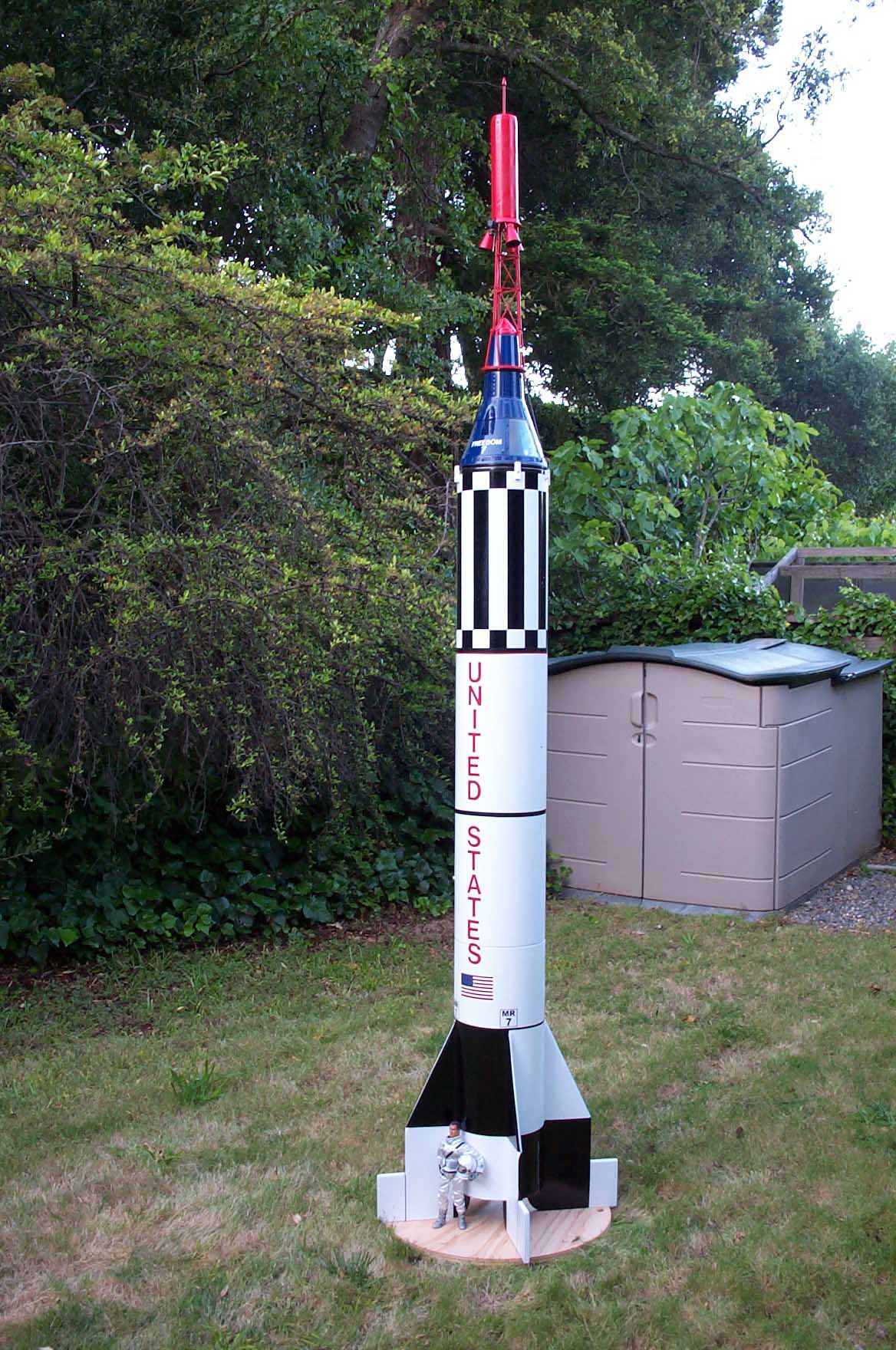
Preface: This L3 project was inspired 39 years ago when I got a GI Joe Mercury Capsule for my birthday. I always imagined it flying (even orbiting) and it kept me out of my parent's hair for days on end.  Fast-forward to the mid 90s when the GI Joe Capsules are re-issued by Toys-R-Us -- naturally I picked up one (well 3).  After the popularity and success of the Gumby flights I simply had to look to the shelf above my workstation to be inspired for my next big project.  When I found a tube that was 9.25" (the exact diameter of the Capsule base), this project was set into motion.


Project goal: To send a full GI Joe capsule aloft (with Astronaut), have the capsule free-fall and deploy its recovery system safely.  The entire flight will be recorded by three different on-board video systems.

Note: This ISN'T a scale project; the "Mercury Booster" will be much shorter than the real thing.  The "Mercury" capsule, being built from the GI Joe unit, is under scale as well. 

The big challenge of this project is to perfect a system that allows the capsule to free-fall to a safe altitude before deploying its parachutes. Technically this is no more than a dual deployment flight, but the added complication of extracting the tower so the capsule can free-fall is anything but simple.

  • At apogee the capsule (with  tower) will decouple from the booster.  This also releases the hold-down straps for the Tower.

  • The capsule has a deployment bag attached to the heat shield which will pull out the drogue chute for the booster.  

  • The decoupling activates an ejection charge timer inside the tower, allowing for the capsule and tower to drift away from the booster (which should be unfurling its drogue chute).

  • Once the tower charge has fired and its chute has inflated, the weight of the capsule should cause it to fall free off the tower base.

  • The capsule will free-fall to about 1000' before deploying a drogue that will subsequently deploy the main chute.  

With all going to plan, the Tower (fitted with fairly large chute) should record the free fall and recovery of the capsule and the booster, but a lot of that depends on how the tower swings.

It should be pretty entertaining to watch, especially on the video replays.